

- Search
 Lot I-10-7, D7 Street, Saigon Hi-Tech Park, Tang Nhon Phu Ward, Thu Duc City, HCMC
 (+84) 28 7301 3688
 Info@wembleymed.com.vn
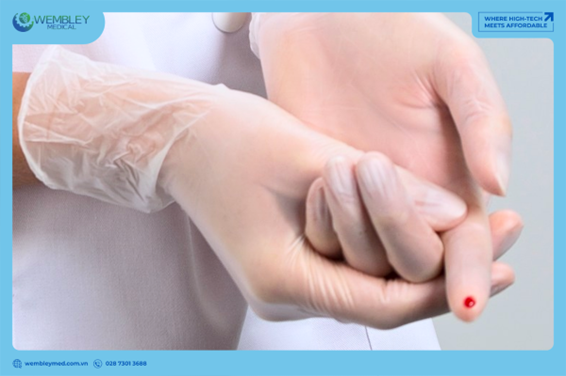
There is a moment that nearly every nurse or laboratory technician has experienced at least once in their career: a slight tremor in the hand, the needle slips, and a sharp, cold sting runs down the finger. Within seconds, a series of urgent questions follow: Does this patient carry any pathogens? Is urgent testing required? Will the coming months be spent waiting anxiously for results?
This is the reality of needlestick injury: one of the quietest yet most persistent occupational hazards in healthcare. And the question the scientific community has spent years attempting to answer is whether technology can eliminate this risk entirely.
1. About the Study
1.1. Study Overview: Safety Devices for Preventing Needlestick Injuries
According to the World Health Organization, tens of thousands of cases of HBV, HCV, and HIV infection occur worldwide each year as a result of occupational exposure in healthcare settings, with needlestick injury rates remaining at approximately 1 - 5 cases per 1,000 healthcare workers annually.
In response to this issue, Cochrane conducted a systematic review of 24 clinical studies, involving tens of thousands of healthcare workers across 9 countries, to compare the degree of reduction in percutaneous injuries between medical devices incorporating safety features and traditional devices.
1.2. Comparative effectiveness of active and passive safety devices
The Cochrane review classifies medical devices incorporating safety features into two primary categories based on their mechanism of operation:
Pooled analysis of the data showed that active safety devices were associated with an increased rate of blood-splatter incidents compared to the use of conventional devices. The underlying technical explanation is that, because these safety mechanisms depend on an additional manual action, the risk of the user forgetting to activate the mechanism or performing it incorrectly remains significant under high clinical workload and time pressure.
By contrast, passive safety devices, in which the protective mechanism is directly integrated into the fundamental design of the product, demonstrated more stable and consistent preventive effectiveness. This finding confirms that optimal clinical safety is achieved when device design fully eliminates the possibility of human error.
1.3. Risk factors in syringe-based blood collection and the vacuum blood collection solution
In the traditional method using a separate syringe, the technician must perform a manual sample-transfer step: piercing the needle of the blood-filled syringe through the rubber cap of the collection tube to transfer the sample. This is classified as an active action, requiring manual force control, and is associated with the highest probability of needle-slip incidents and blood exposure within the entire procedure.
Vacuum blood collection systems are designed to completely eliminate this hazardous step. Through precisely calibrated negative pressure within the collection tube, blood flows automatically from the patient's vein through a sealed needle-and-holder system directly into the collection tube. This closed-system process entirely removes the manual step of piercing the rubber cap, thereby substantially controlling the risk of percutaneous injury and occupational exposure among healthcare workers.
1.4. The role of healthcare policy and consistency in clinical practice
Pooled analysis across intervention categories indicates that the implementation of regulatory requirements or mandatory hospital policies for the use of safety medical devices yielded the clearest and most consistent evidence of reduced needlestick injury rates (moderate-quality evidence). This finding confirms that optimal preventive effectiveness is achieved only when the deployment of safety devices is accompanied by consistent management policy, standardized procedural protocols, and ongoing staff training programs.
With regard to methodology, the authors of the Cochrane review note that the majority of available clinical studies exhibit certain design limitations, including risk of bias and difficulties in achieving randomization at a hospital-wide scale. However, these statistical limitations reflect the objective methodological challenges of conducting community-level intervention research within healthcare institutions, and do not indicate a lack of effectiveness of safety devices in real-world clinical practice.
2. VATRACY Vacuum Blood Collection Tubes - An optimal solution for safe blood collection
The safety principle identified by the Cochrane review is clear: genuine safety comes from design that eliminates hazardous actions, rather than from relying on human vigilance.
This is precisely the same principle applied in the design of VATRACY Vacuum Blood Collection Tubes.
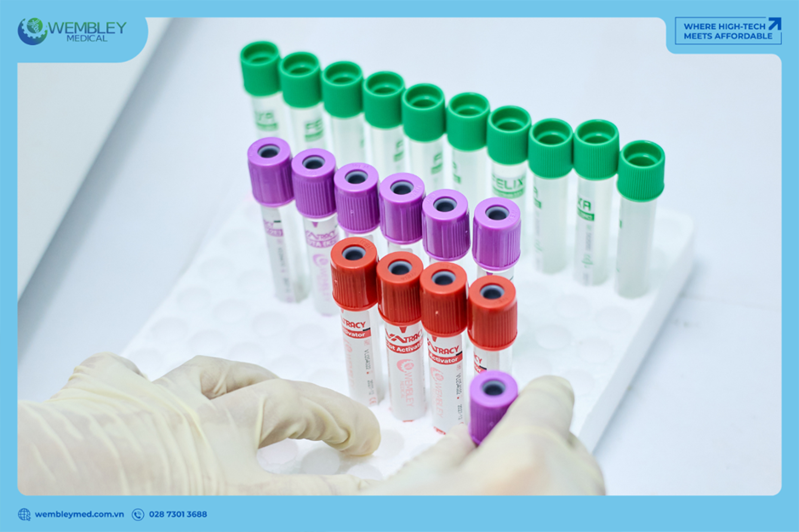
Utilizing a sealed needle-and-holder system, blood is drawn directly from the patient's vein into the collection tube through the tube's built-in negative pressure, eliminating the need for technicians to hold a syringe and pierce it through a rubber cap as required by the traditional method - thereby removing, at its source, the very action associated with the highest risk of needlestick injury.
Researched and designed by WEMBLEY MEDICAL, the product is manufactured on automated production lines within a Class 100,000 cleanroom, controlled by a quality management system certified to ISO 13485:2016, ISO 9001:2015, ISO 14001:2015, and GMP, with the following key advantages:

VATRACY Vacuum Blood Collection Tubes are suitable for use in hospitals, clinics, and testing laboratories, supporting standardized sample collection procedures while protecting both healthcare worker safety and sample quality.
For further product information, please contact our Hotline at (+84) 28 7301 3688 for prompt support.


VATRACY vacuum blood collection tubes offer the following benefits:
The VATRACY No Additive vacuum blood collection tube body is made from transparent polyethylene terephthalate (PET), offering excellent impact resistance and minimizing chemical evaporation. The polyethylene (PE) cap features a highly elastic rubber stopper, ensuring smooth needle penetration and secure sealing to prevent leakage during transport and laboratory handling.
The entire production process for the tubes is conducted using an automated assembly line in a Class 100,000 cleanroom. The process adheres to a quality management system certified to ISO 13485:2016, ISO 9001:2015, ISO 14001:2015, and GMP standards. The product is certified to meet European CE Marking standards and has obtained Certificates of Free Sale (CFSs) for the United Kingdom and Spain.
VATRACY No Additive vacuum blood collection tubes are sterilized using irradiation, which eliminates microorganisms while preserving the integrity of the reagents and preventing risks to test results caused by bacteria.
Sources: Reddy VK, Lavoie MC, Verbeek JH, Pahwa M. "Devices for preventing percutaneous exposure injuries caused by needles in healthcare personnel." Cochrane Database of Systematic Reviews, 2017, Issue 11, Art. No. CD009740.